
AKHAAN — PUNJAB ILLUSTRATED · IIP-PB-0007
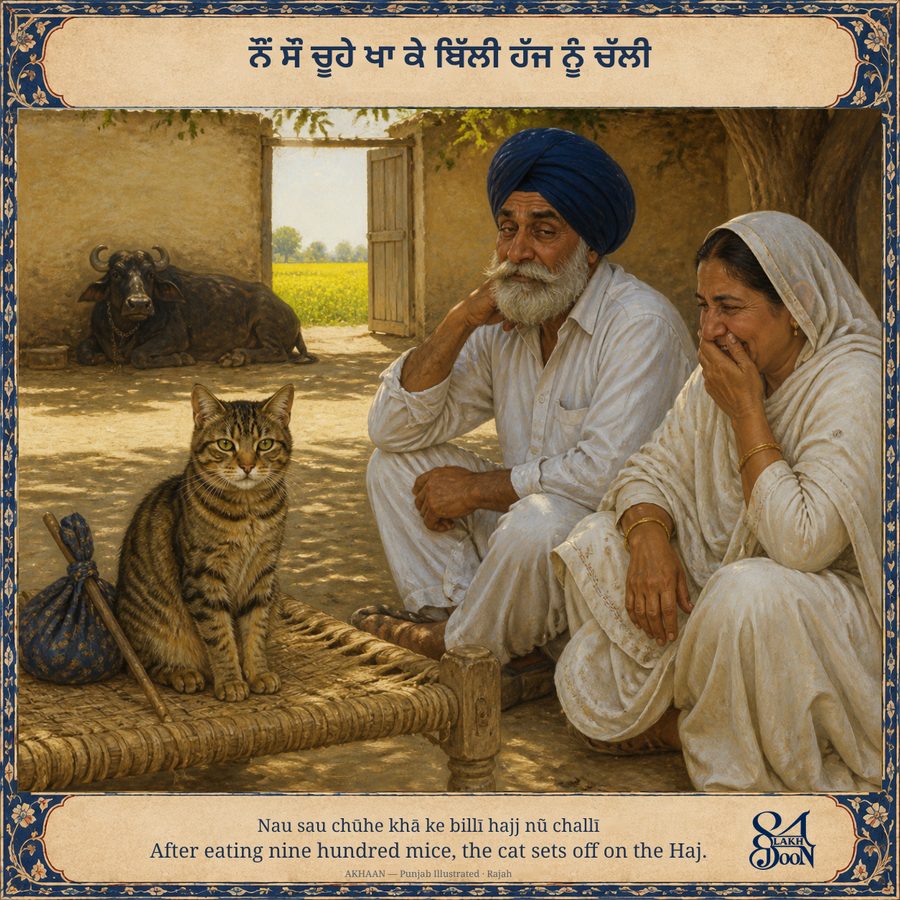
ਨੌਂ ਸੌ ਚੂਹੇ ਖਾ ਕੇ ਬਿੱਲੀ ਹੱਜ ਨੂੰ ਚੱਲੀ
Nau sau chuhe kha ke billi hajj nu challi — After eating nine hundred mice, the cat sets off on the Haj
Status: Institute Approved, 1 November 2026
What it means
A cat has eaten nine hundred mice. Now she ties up a bundle and sets off on the Haj. The joke is how sudden it is.
It's said of someone who has done a great deal of wrong and then turns up pious, or sorry, or reformed, just when it suits. Two readings are in print: a fake change of heart, and a change of heart that comes far too late.
The joke is the cat, not the pilgrim.
Where it comes from
The Haj in the picture tells us it grew up among Muslim speakers. It was already in print in Persian by 1824 and in Hindustani by 1886. The idea of a cat playing the holy man is older still in India, but we have not yet traced that line.
The number of mice changes with the teller: seven hundred, nine hundred, or simply hundreds.
In print
- 1824, Calcutta: Thomas Roebuck's collection of Persian and Hindoostanee proverbs has it in the Persian part, with seven hundred rats: a very wicked person who pretends to have become penitent and religious.
- 1886: S. W. Fallon's Dictionary of Hindustani Proverbs gives it with nine hundred rats and reads it as a death-bed repentance, at the eleventh hour.
- 1905: C. F. Usborne's Panjabi Lyrics and Proverbs has it among Punjabi sayings, in English translation: the cat devours hundreds of mice and then thinks of a pilgrimage to Mecca.
We have not yet found it in old print in Punjabi script.
Can you help?
We have not yet found this proverb in old print in Punjabi script. If you know an old book, song or family saying with these words, please contact the Institute. Everything sent in is checked, and anyone whose find is confirmed is credited.
Handle with care
The Haj is one of the five pillars of Islam. The pilgrimage in this saying is sacred to Muslims. We found no history of the proverb being used against any group, but the words are the same whoever says them.
- Said by a Muslim about a hypocrite, it criticises hypocrisy inside the faith. Said about Muslim pilgrims, or about a Muslim who has become more devout, it mocks a sacred act. Please don't use it that way.
- It can be turned on someone who has truly changed, such as a person who has stopped drinking or left a life of crime. People do change. Not every late change of heart is a cat with a bundle.
- In the saying the hypocrite is a female cat. It can be said of anyone, not only women.
Why it matters
It's a proverb with a picture you can't forget: a well-fed, pleased cat, a bundle on a stick, and nine hundred reasons to look the other way. It also shows one story travelling through Persian, Hindustani and Punjabi, and how the same punchline can mean fake piety to one speaker and too-late sorrow to another.
The full research record, with sources, is available from the Institute on request. Corrections and comments are welcome.