
AKHAAN — PUNJAB ILLUSTRATED · IIP-PB-0005
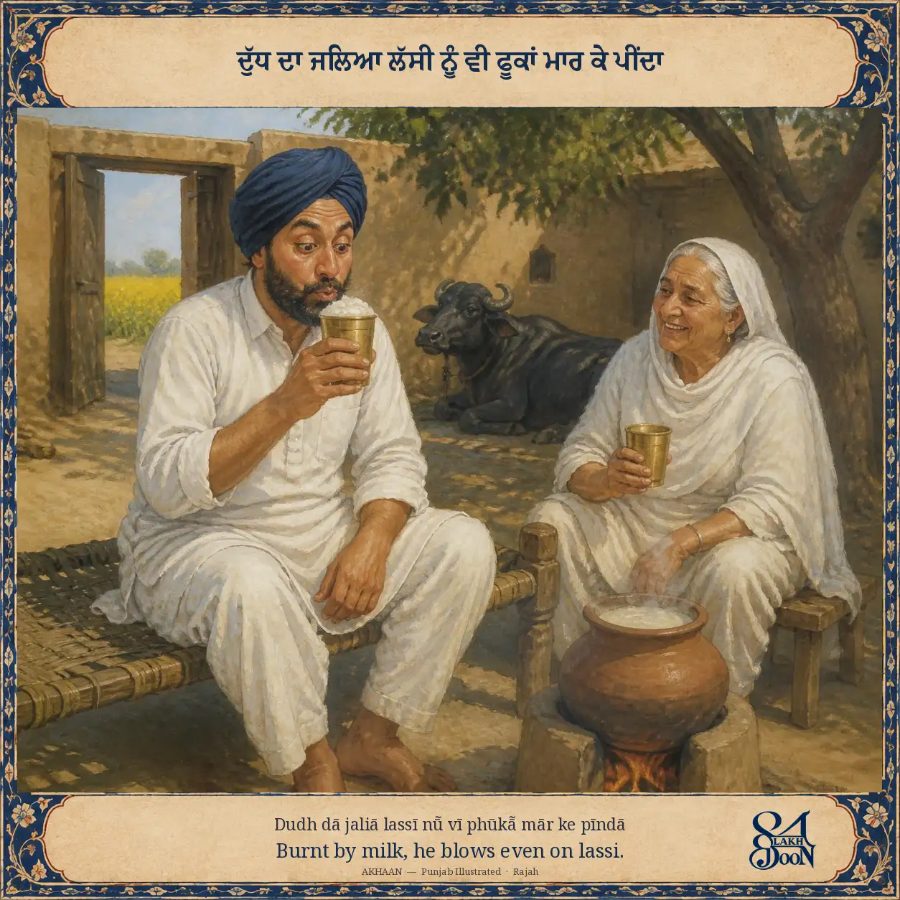
ਦੁੱਧ ਦਾ ਜਲਿਆ ਲੱਸੀ ਨੂੰ ਵੀ ਫੂਕਾਂ ਮਾਰ ਕੇ ਪੀਂਦਾ
Dudh da jaliya lassi nu vi phookan maar ke peenda — Burnt by milk, he blows even on his lassi
Status: Institute Approved, 1 November 2026
What it means
Someone once scalded their mouth on hot milk. Now they blow on a glass of lassi before they drink it. But lassi is cold. There's nothing to cool.
It's said of anyone who has been hurt once and is now careful about everything, even things that can't hurt them. The fear has outlived the danger. In English we say “once bitten, twice shy”.
It can be said kindly (“no wonder he's careful, after what happened”) or with a smile (“you're blowing on cold lassi now”).
Where it comes from
This saying belongs to a whole belt of milk-and-yoghurt country, from Turkey across Iran to Punjab.
- Punjabi: milk and lassi.
- Hindi and Urdu: milk and chhachh, buttermilk.
- Persian: milk and buttermilk, recorded in 1824 (see below).
- Turkish: “one whose mouth was burnt by milk eats yoghurt blowing on it”. Turkey's language authority, the TDK, glosses it as someone who has learned their lesson and stays alert.
Did it travel along the old routes between these peoples, or did each dairy culture find the same image for itself? The Persian record makes a shared line more likely, but it doesn't prove it. We can't say for certain.
Europe has the same idea with different pictures: the burnt child dreads the fire; the scalded cat fears even cold water. Both were already in Thomas Fuller's English collection of 1732. French has its own scalded cat, chat échaudé craint l'eau froide, which a French dictionary of expressions traces back to the 13th century.
In print
- 1824, Calcutta: Thomas Roebuck's collection records it twice: in his Persian proverbs (“he that has been scalded with milk, blows when he drinks butter-milk”) and again in his Hindustani ones.
- 1886, Banaras: S. W. Fallon's Dictionary of Hindustani Proverbs records Dudh ka jala chhachh phunk phunk pita hai: scalded with hot milk, he blows on buttermilk to cool it.
We have not yet found it in old print in its Punjabi wording, with lassi. The search goes on.
Can you help?
We have not yet found this proverb in an old Punjabi book. If you know one, or a family collection, a song or a recording where it appears, please tell us in the comments or contact the Institute. Everything sent in is checked, and anyone whose find is confirmed is credited.
Handle with care
We found no history of the proverb being used against any group. But how it's used matters:
- Caution can become prejudice. “I was cheated by one of them, so now I'm careful with all of them.” The same words that praise good sense can be used to excuse treating a whole community as suspect because of one person.
- Said to someone who has been badly hurt, it can sound like “you're over-reacting”, when their caution is entirely reasonable.
The words are the same; the meaning depends on who says it, and to whom.
Why it matters
It's a proverb you can taste: hot milk, cold lassi, a puff of breath. And it reaches from Istanbul to Amritsar, a reminder that the same kitchens, and the same lessons, run right across the old dairy lands of Asia.
The full research record, with sources, is available from the Institute on request. Corrections and comments are welcome.