
AKHAAN — PUNJAB ILLUSTRATED · IIP-PB-0004
ਦੂਰ ਦੇ ਢੋਲ ਸੁਹਾਵਣੇ
Door de dhol suhaavne — Drums from far away sound pleasant
Status: Institute Approved, 6 October 2026
What it means
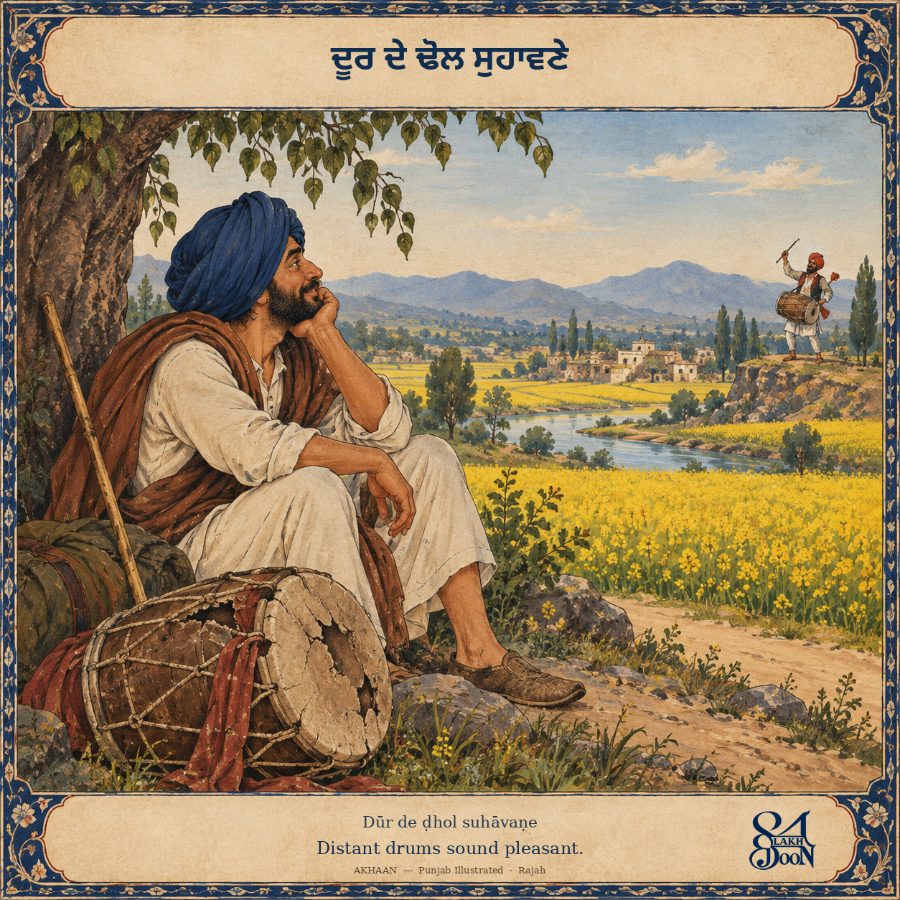
Things far off seem better than they really are. A drum heard across the fields at dusk sounds sweet. Stand next to the drummer and it's deafening.
People use it in a few ways. In Urdu it's said when someone absent, or something absent, is praised more than they deserve. In Persian it's also said of people whose noise is bigger than their skill.
Where it comes from
This saying is shared across languages. It's found as a proverb in Punjabi, Hindi, Urdu and Persian.
Its best-known early form is Persian. It is the last line of a four-line poem credited to Omar Khayyam: the sound of the drum is sweet heard from afar. In the poem, the distant drum is the paradise promised to the pious, and the poet prefers what is in hand today. Edward FitzGerald brought it into English in 1859: “Oh, the brave Music of a distant Drum!”
Did Khayyam borrow an older saying, or did his line become a proverb? Nobody knows. We have found no evidence either way, and we say so plainly.
In print
- 1824, Calcutta: Thomas Roebuck's collection of Persian and Hindustani proverbs records it in both languages.
- 1886, Banaras: S. W. Fallon's Dictionary of Hindustani Proverbs records it as Dūr ke dhol suhāwane. Fallon marks it as a saying used by women.
We have not yet found it in print in its Punjabi wording. The search goes on.
Can you help?
We have not yet found this proverb in an old Punjabi book. If you know one, or a family collection, a song or a recording where it appears, please tell us in the comments or contact the Institute. Everything sent in is checked, and anyone whose find is confirmed is credited.
How it's used today
It's still in everyday use. Punjabi writers use it about the pull of faraway places: Canada, America, Australia, New Zealand. Sometimes it's a warning; just as often it's said with pride. Urdu poets still open verses with it.
Handle with care
We found no history of the proverb being used against any group. Two things are worth knowing:
- Said to someone who has emigrated, it can sting, as if to say “you were fooled”. The words are the same; the meaning depends on who says it, and to whom.
- In parts of North India, dhol playing was historically linked to communities treated as low caste. Our image shows the drummer with dignity.
Why it matters
A line of Persian poetry travelled into the speech of North India, was written down by collectors in Calcutta and Banaras, and is still on the lips of Punjabis who left for distant shores. Some proverbs carry a whole history inside them, and this is one of them.
The full research record, with sources, is available from the Institute on request. Corrections and comments are welcome.