
AKHAAN — PUNJAB ILLUSTRATED · IIP-PB-0003
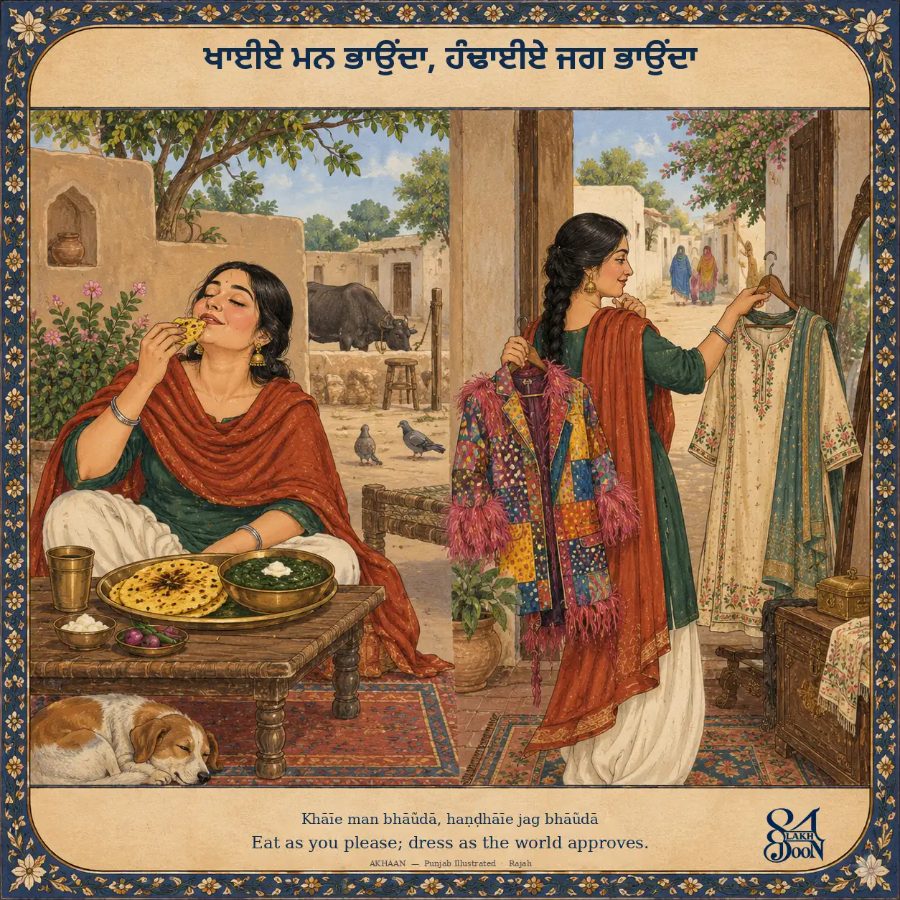
ਖਾਈਏ ਮਨ ਭਾਉਂਦਾ, ਹੰਢਾਈਏ ਜਗ ਭਾਉਂਦਾ
Khaaiye man bhaunda, handhaaiye jag bhaunda — Eat what pleases you, wear what pleases the world
Status: Institute Approved, 1 November 2026
What it means
Your plate is your own business. Your clothes are seen by everyone.
So eat whatever you like at home. When you step out, dress in a way the people around you will accept. It draws a line between private life and public life.
Where it comes from
This is one of the most widely shared proverbs we have come across. The same advice turns up, almost word for word, in places with no obvious link to each other:
- Punjabi, Hindi and Urdu: khaaiye man bhaunda, handhaaiye jag bhaunda; in Hindustani, khaiye man bhata, pahniye jag bhata.
- English: Benjamin Franklin printed “Eat to please thyself, but dress to please others” in his Poor Richard's Almanack for 1738.
- Arabic: in Egypt, “eat what pleases you, and wear what pleases people” is still in use today.
Did it travel from one to the other, or did each people arrive at the same idea on its own? We can't say. Franklin often reworked older sayings, so his version may not be the first. We have found no evidence either way.
In print
- 1738, Philadelphia: Franklin's Poor Richard's Almanack, in English.
- 1886, Banaras: S. W. Fallon's Dictionary of Hindustani Proverbs records Khaiye man bhata, pahniye jag bhata: eat to please yourself, dress to please the world. He also records a version about speech: speak to please the world, eat to please yourself.
We have not yet found it in old print in its Punjabi wording. It appears in today's Punjabi proverb collections in exactly the form above.
Can you help?
We have not yet found this proverb in an old Punjabi book. If you know one, or a family collection, a song or a recording where it appears, please tell us in the comments or contact the Institute. Everything sent in is checked, and anyone whose find is confirmed is credited.
Food and clothing in Gurbani
The proverb itself has no religious meaning. But it's worth knowing that Guru Nanak's shabad on Ang 16 of Guru Granth Sahib, in Sri Raag, takes up the same two things, food and clothing. It says that eating or wearing anything that harms the body and fills the mind with wrong thoughts brings no real happiness (ਬਾਬਾ ਹੋਰੁ ਖਾਣਾ ਖੁਸੀ ਖੁਆਰੁ … ਬਾਬਾ ਹੋਰੁ ਪੈਨਣੁ ਖੁਸੀ ਖੁਆਰੁ).
Gurbani asks a different question from the proverb: not “whom does it please?” but “what does it do to you?” We record this side by side, without judgment.
Handle with care
We found no record of the proverb being used against any group. But “dress to please the world” is advice to fit in, and that can cut both ways:
- Faith you can see. Said to a Sikh abroad, “dress to please the world” can mean: lose the turban. In 1967 a Sikh bus driver in Wolverhampton, Tarsem Singh Sandhu, was sent home for wearing his turban and beard. After a two-year campaign the ban was lifted in April 1969. The same pressure falls on the hijab, the kippah and other visible faith dress.
- Women. Rules about dress fall hardest on women. The proverb can be used to police what women wear.
The words are the same; the meaning depends on who says it, and to whom.
Why it matters
The same advice, in Philadelphia, Cairo and a Punjabi village: that tells us something about people everywhere. And the questions it raises, about fitting in and staying true to yourself, are as live today as ever.
The full research record, with sources, is available from the Institute on request. Corrections and comments are welcome.