
AKHAAN — PUNJAB ILLUSTRATED · IIP-PB-0001
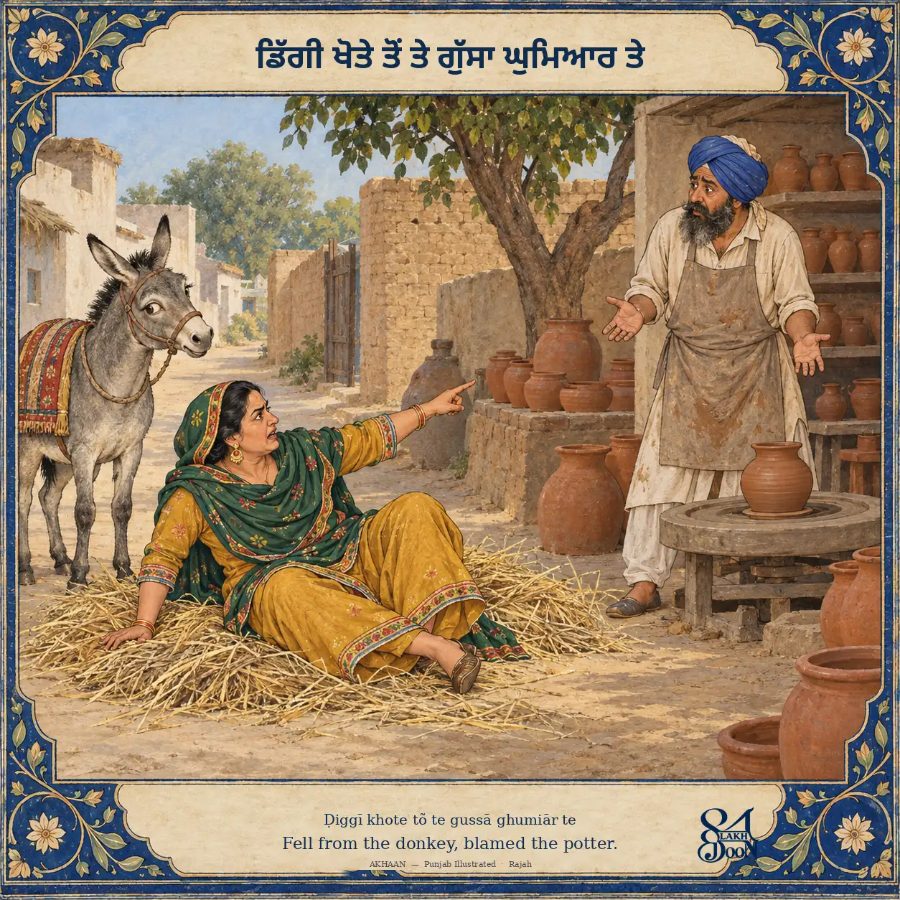
ਡਿੱਗੀ ਖੋਤੇ ਤੋਂ ਤੇ ਗੁੱਸਾ ਘੁਮਿਆਰ ਤੇ
Diggi khote ton te gussa ghumiar te — Fell off the donkey, angry with the potter
Status: Institute Approved, 1 November 2026
What it means
You fall off the donkey. Whose fault is that? Yours, perhaps, or the donkey's. But you turn round and shout at the potter who owns it.
It's said of anyone who blames the wrong person: the one nearest to hand, or the one who can't answer back, instead of the one really at fault.
Where it comes from
The potter and his donkey are old companions in North Indian sayings. For generations the potter used a donkey to carry clay and pots, and the pair turn up again and again in the proverbs of the region.
Its older cousins, in Hindustani, send the anger the other way. In 1886 S. W. Fallon recorded “unable to settle with the potter, he takes it out on his donkey”, and “the potter's wife's anger falls on the donkey”. Both are about the same thing: anger that lands in the wrong place. The Punjabi saying turns it round. Here the donkey throws you, and the potter gets the blame.
Which came first, we can't say. We have found no evidence either way.
In print
- 1886, Banaras: Fallon's Dictionary of Hindustani Proverbs records the two Hindustani cousins above. It does not have the Punjabi form.
We have not yet found the Punjabi wording in old print. It appears in today's Punjabi proverb collections. The search goes on.
Can you help?
We have not yet found this proverb in an old Punjabi book. If you know one, or a family collection, a song or a recording where it appears, please tell us in the comments or contact the Institute. Everything sent in is checked, and anyone whose find is confirmed is credited.
How it's used today
It is very much alive on both sides of the border. In October 2026 a Punjabi politician used it in Punjabi Jagran to accuse a rival party of passing the blame. In 2017 a Lahore newspaper, Daily Pakistan, used the Shahmukhi form as a headline about officials blaming others.
The wording shifts a little. In the Gurmukhi form it's a woman who falls (ਡਿੱਗੀ). In the Pakistani form it's a man who falls, from a she-donkey (ڈگیا کھوتی توں).
Handle with care
We found no record of the proverb being used against any group. Three things are worth knowing:
- The potter is a real community, not a joke. In the 1890s, writers recorded that keeping a donkey was looked down on and tied to castes treated as low. In this proverb the potter is the innocent one, wrongly blamed. Our image shows him as a skilled craftsman, with dignity.
- Who falls? In one common form the person who blames others is a woman. Said by a man about a woman, it can carry an old jibe. In the Pakistani form it's a man. The meaning is the same either way.
- Who says it to whom. When someone with power uses it to push blame down onto a junior, the proverb becomes the very thing it describes.
Why it matters
It's a small joke with a sharp point. We all know the person who kicks the nearest thing when they trip. This proverb gives that person a donkey, a potter and a village lane, and it still lands in today's headlines on both sides of the border.
The full research record, with sources, is available from the Institute on request. Corrections and comments are welcome.